Saturday, October 20, 2018

Holiday in England - part 2/2

The second week of our holiday was spent in the south east, mainly in Ivor's home county, Kent. I will write a separate account of our day trip to Lille, France.

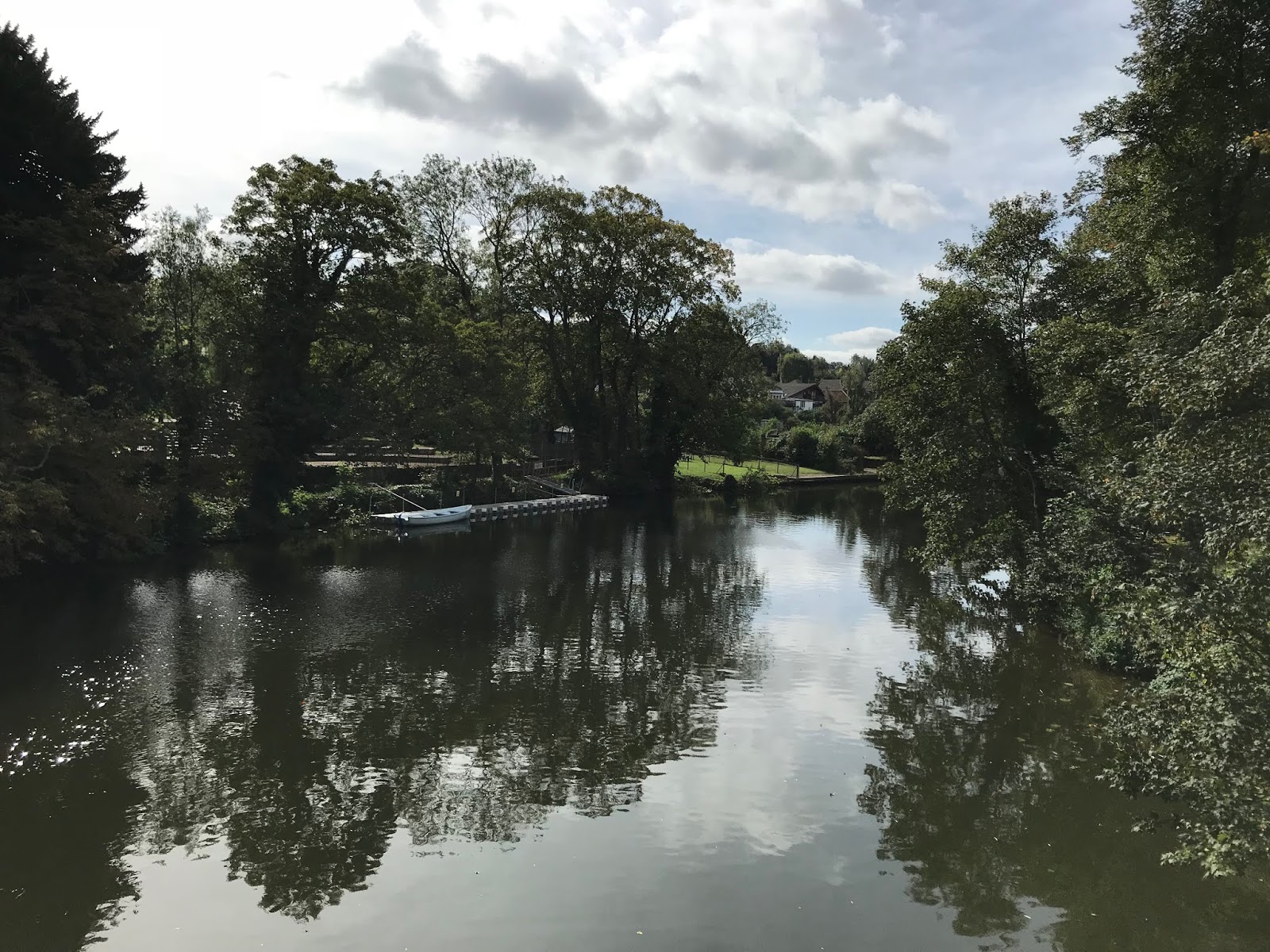
We visited Maidstone, where we enjoyed the river and the old buildings.


The next day we went up to London. First we visited the Guildhall, where we saw the remains of a Roman amphitheatre, the Great Hall, and St. Lawrence Jewry Church.


After lunch, we wanted a peaceful place to relax. We went to Bunhill Fields cemetery, where we saw the tombstones of Daniel Defoe, William Blake, and others. We sat on a bench and watched people on their lunch break, and also spotted some squirrels. We don't get squirrels in Israel, so I enjoy seeing them in England.


Next, we visited Shoreditch, a part of London that is becoming gentrified and hipster. We saw evidence of this, and also of the resistance to this trend in the local graffiti. We visited the Brick Lane Bookshop, which had a good selection of political and radical books. I overheard someone say "Oh yes, Dostoyevsky's Crime and Punishment"! We passed by several hipster-type establishments, including the famous Cereal Killer café and places selling vinyl records and rainbow bagels (or "beigels"!).


Our reason for visiting this part of London was Lady Dinah's Cat Emporium. This is a cat café, housing several cats, and decorated with a Through the Looking Glass theme. We went into the basement, where we were able to interact with the cats. We were served afternoon tea, with sandwiches and cakes. I had the vegan/dairy-free option, and there was too much food to finish. Unlike in some cat cafés, most of the cats are not available for adoption but are permanent residents. This was an enjoyable experience, and  I was pleased to see that all the guests were respectful of the cats.


The next day we had another animal-related visit, this time to Buttercups Sanctuary for Goats. We were able to feed the goats cornflakes and dry pasta.


Later we visited Tenterden, another picturesque town. I was pleased to find a Tiny Free Library and to see a bee in the fuchsias.


Another place we visited in Kent was Stoneacre House, a lovely 15th century home and garden.


Rye in East Sussex is a lovely coastal town. We visited the Ypres Tower, with its impressive views, walked along Mermaid Street, and visited Lamb House, home of Henry James.


The morning before our return home, we had a walk in Hawley Wood for a welcome final dose of English green.


We also visited the Old Windsor branch of the Battersea Dogs and Cats Home, but photography was forbidden. This was my second visit to this place, and I was once again impressed with the facility. This was a lovely conclusion to a very enjoyable holiday.

Wednesday, October 3, 2018

Holiday in England 2018 - part 1/2

We spent the first half of September in England, four years after our previous visit. Our trips to England combine the following: meeting family and friends and their pets; visiting places of natural beauty and historical interest, and places related to animal rescue and welfare; eating (too much) delicious food; and some shopping. This time we had fifteen days, which is a substantial time for a holiday. It also gave us an opportunity to reconnect with our Englishness and to fantasize about what our lives would be like if we could live in England. We do this with other places we visit, such as Greece, but moving to England somehow feels more natural, as we have citizenship and relatives living there. It's unlikely to happen, but still fun to imagine.

When I arrived in England, I immediately drank in the soft, green nature and the calmer atmosphere. Spending time in nature is good for the soul. Trees, fields, rolling hills, bird song, the sea. The towns and places we visited were also full of a specific English character, or, more accurately, reflected various aspects of being English. We stayed in the south, and only one day was spent in London, in contrast to many overseas visitors who never leave the capital.

Some general comments about England. We noticed the growing number of wind turbines and solar panels creating non-polluting energy, and every shop assistant asked whether we needed a bag instead of thrusting one on us and us having to refuse it, as often happens here. In this respect there seems to be some improved environmental awareness. However, the supermarkets were full of over-packaged processed food, sometimes packaged in small quantities, which makes it even more wasteful. Some types of packaging are recycled, but reducing packaging is more effective than recycling.

Another thing that hasn't changed from our previous visit is the reluctance to accept fifty pound notes (bills), with some shops displaying a sign saying that they won't take them. In other countries, notes of equivalent value are accepted without problem, and I don't understand why English shops have a problem with them. However, the world is moving to a cash-free economy, so eventually there won't be any notes and everything will be done digitally.

This report will focus on the places we visited. Our first week focused on the central and western parts of southern England.

Our first trip was to Odiham Castle, a ruined castle built in 1207 by King John. We walked along the Basingstoke Canal and explored the remains.


The next day we visited Winchester. A flower festival was being held in the Cathedral, with flower-based installations inspired by the Winchester Bible's illuminations.


Winchester itself is very beautiful, and I like the statue of King Alfred.


The next day we drove west. After a brief stop near Stonehenge (which we visited on a previous trip), we spent some time at the Donkey Sanctuary in Sidmouth. We enjoyed seeing the happy rescue donkeys in their fields and shelters.


We continued to Plymouth, where we met up with Ivor's best friend from school after 40 years. His part of Plymouth was very green and had excellent views of the countryside.


After staying overnight in Plymouth, we continued to Cornwall, a place where my family has spent many holidays over the years. We went to the beach at Mawgan Porth and on the cliffs at Carnewas.


Then we walked around Padstow, which retains much of its character despite becoming increasingly touristy.


Thursday, August 30, 2018

Ten Years of Blogging

Yesterday marked the tenth anniversary of this blog, Reality and Fiction. It's only fitting that I use this platform to express what having this creative outlet has meant to me over the past decade.

Over the past ten years, I have written about various aspects of reality and fiction, as the title implies. The fiction bit was easy: reviewing books I've read. The reality aspect covered various things that happened in my life and in the world around me, including some ethical discussions of political and religious issues, reports of travel, concerts, and of traumatic events like fires, and some of the things I do online, such as watching kitten cams.

I never intended to make money out of this blog, and in fact I haven't, though I put up Amazon affiliate links to the books I review. Its purpose was different. I wanted this to be somewhere for me to get across my thoughts and reach readers. It combined two aspects: creative and public.

Creatively, writing this blog has been good practice for me. I enjoy writing essays about issues, and the length of a blog post seems to suit my style. As a writer, everything I write counts as practice and experience, so I was glad to have a place for my own writing. I enjoy thinking about what I want to write, then organizing the structure of the essay, sometimes in my head before I start writing, but more often I write and reorganize until it flows well. Editing my own writing has also made me a better editor and translator, so there's a professional benefit too.

In terms of making my writing public, this has also been a good experience for me. Knowing that at least a few people will read what I'm writing has made me try to see my words from the outside, as if I'm someone else reading them, without the context of my own mind. I've also received some feedback from readers. People enjoy both the contents of my essays and my writing style, and it gives me great satisfaction to know that I'm giving people some pleasure or interest.

Someone once asked me if I wasn't shy about having my personal blog read by strangers. I explained that this was the whole point, to reach other people and share my thoughts with them. As an introvert, I don't often open up to strangers, and very few people know me completely. This allows me to control what I want others to know about me, and to push beyond my shy comfort zone. It's good preparation for when I finally publish my books.

My blog's readership is usually quite small, because I don't really make an effort to promote it beyond my own social media. When I write on a topic that interests any of my groups, such as my reports about translation conferences or when I write about something related to the kitten cams I watch, I let the relevant groups know about the blog post and sometimes get a much larger readership. Sometimes people have shared my blog posts to their social media, or included links to specific posts on their websites.

While there have been times when I made an effort to write every week or so, there are often times when I don't write very frequently for various reasons. Realizing that the blog has been around for ten years has made me aware of how much I appreciate having this creative outlet and form of public communication, and I hope it will encourage me to write more frequently again. 

Readers, if you have been following this blog for all or part of its ten years, thank you for your attention and I hope you will continue to enjoy my future posts!

Monday, June 4, 2018

Imperfection is liberating

Nobody's perfect - and that's a good thing!

I often get annoyed when I see motivational slogans like: "You're perfect just the way you are" or "Don't let anyone tell you to change". These sentiments are supposed to increase people's self-confidence and self-love, but it seems to me that they're wrong in two ways.

First of all, what is perfection anyway? People have so many different characteristics that even if we could agree on what perfection is in each of them, nobody could be perfect in all of the characteristics. Indeed, some are contradictory. You can't be a perfect introvert and also a perfect extrovert.

Secondly, to tell someone they're already perfect and don't need to change is to stifle their growth. It means they should freeze themselves as they are and never develop, never acquire any new skills or traits. Also, people may have some negative characteristics and attitudes that are really worth changing, for their own sake and for the sake of others around them. They are imperfect in a negative way that actually requires some work.

We are all born as helpless babies with some predispositions, tendencies, and personality traits already present. From this moment onwards, we grow and change as a result of the interaction between nature and nurture. If we are lucky, our nurture will encourage our innate strengths and steer us away from our innate weaknesses. For example, encourage us to develop our musical talent or our writing skill, while not exposing those with a predisposition to addiction to the dangerous behaviours that can destroy lives.

Acknowledging that there's no such thing as perfection, and that we'll never be perfect, frees us to decide what to learn in life and how to develop. We can improve in whatever direction we want, from whatever starting point we happen to be at. It's never too late to change and grow, and because we don't have to be perfect, we can be anywhere on the scale. If our criterion is not perfection but progress, we can balance having a positive self-image with having a desire to continue improving.

I would prefer the motivational slogans to say: "You are imperfect and therefore free to change in whatever way you choose" and "If someone points out something you should change, decide if that's something worth changing, they might be right".

Wednesday, May 2, 2018

Say no to bonfires

When I immigrated to Israel at age 9, I had to get used to the local traditions. Many things I found strange and incomprehensible. At Lag BaOmer, my class used to get together in the afternoon, "take" (= steal) a shopping trolley (cart) from a supermarket, and go around "collecting" wood for the bonfire. Sometimes there were dry branches lying around in a park, but usually this meant stealing wood planks from building sites. The parents and teachers knew about this stealing and turned a blind eye to it.

In the evening, the celebration itself involved lighting a bonfire in an open area, usually a sandy patch not far from buildings and roads, and sitting around, roasting potatoes, singing, telling stories, and toward the end of the bonfire someone would usually try to throw a spray can into the fire to see if it would explode. The smell of smoke lingered and stuck to everyone and everything for days.

The whole thing, from the stealing, to burning a precious resource, to creating air pollution, to the risk of injury and of the fire spreading, to various other types of irresponsible behaviour, seemed alien to my English sensitivities.

I have always disliked the smell of smoke, and two major fires in my city, Haifa, in 2010 and 2016, have made the whole issue of deliberately lighting bonfires particularly traumatic for me. So I was very pleased to read that this year the Haifa municipality, along with those of a few other cities, has banned bonfires for Lag BaOmer. The immediate reason for this is the current hot, dry weather, with strong dry winds blowing from the east, increasing the risk of the fire spreading. As we saw last week, ignoring weather-related risks can cost lives.

I would like to see a permanent end to all bonfires within residential areas. Just because something is traditional doesn't mean it has to persist. We can evaluate the cost versus benefit and change our minds.

Friday, April 20, 2018

How we ended up adopting three kittens

At the beginning of March, we said goodbye to our 18-year-old cat, Eleni. She had been unwell for a long time, and so we had known the end was coming and had thought about our next cats. We decided it would be best to adopt a pair of bonded siblings. Two cats can keep each other company when alone, which is important for indoor-only cats, but we wanted to ensure that they would enjoy each other's company. I also knew from watching kitten cams that cats who have been in foster care are better socialized than many rescue cats who have only lived in shelters.
Eleni

In the past, all our cats have been rescues who came to us. Percy was a pet abandoned by his owners when they moved. Eleni and Pandora were both kittens we found in our garden (not at the same time). So we knew that when the time was right, a cat or cats would appear.

A few days after Eleni's death, my sister's friend Jennie posted on Facebook that she had a feral mother cat and four kittens in her garden, and was looking for adopters for the kittens once they were old enough. We had already arranged to go on holiday, and the time we were going to come home would be about the right time for these kittens to be adopted, so we said we would take two of them. We followed the family's story. The mother cat started neglecting the kittens, so Jennie took them into foster care, kept them warm, and started bottle feeding them. Sadly, two of them didn't make it, but the other two kittens survived and developed well. While it was sad that they were no longer in their mother's care, having the kittens fostered by a human really helped in socializing them and reducing the feral instincts they would have learned from their mother.
Artemis and Cassandra, adoption day

When we returned from our trip, we adopted the two sisters, Artemis (tortoiseshell) and Cassandra (tabby-calico), probably aged 6-7 weeks. The kittens were friendly with us and quickly adapted to their new home. They went to the vet and received the typical deworming treatment and flea drops, and we gradually transitioned them from eating canned kitten food to dry kitten food, which is often considered more nutritious and is easier to manage as it doesn't spoil as rapidly as canned food.
Artemis
Cassandra

A week after we adopted them and were happy at the way they were settling, I went out in the afternoon to buy a new cat tower. I heard a kitten meowing, and saw a young girl looking at a kitten that was under a parked car, and she was talking on the phone. When I got home, she was with her father and they were giving the kitten food and water outside our building. I saw that the kitten looked like Eleni, and felt a twinge of sadness, but I assumed the girl and her father were adopting the kitten, so I went home.

In the evening, when Ivor returned from work, I sent him a message saying that the cat tower was in the car and we would need to carry it up the stairs together. A few minutes later, he called me and asked me to come downstairs. I already knew that this wasn't about the cat tower, and I had a premonition about what was going to happen. This was the way our cat Pandora had adopted us. Ivor had found her in the garden and called me to come down, and that was how we took her in. I went out and found Ivor with the kitten. I was sad that she hadn't been adopted earlier, but also thrilled that we would have another Eleni-lookalike. I called her over, checked to see that she was female, and we chose her name, Penelope. She was about the same age and size as Artemis and Cassandra, and they had only been with us for a week, so we felt confident that they could all get along together.

As we were taking her up the stairs, one of our neighbours came out and saw her. He said he'd found her in the morning inside his car, and hadn't been sure how she had got in there. He seemed happy that we were adopting her. Later, when we carried the cat tower up the stairs, another couple of neighbours saw us and asked what we were doing, and they told us about the kitten who had been around in the garden all day, and were very happy when we said we had adopted her, saying we'd done a mitzvah.
Penelope

The next day I took Penelope to the vet, and while there was some initial surprise that we had taken in a third kitten so soon after the other two, when they saw that she looked like Eleni, they all understood. In the days that followed, the kittens got to know each other, and after some hissing at first, they seem to have accepted each other quite easily. Artemis and Cassandra are still closely bonded, and Penelope is a bit older and larger, and enjoys pouncing on them playfully. Sometimes their play-fighting seems a little rough and I separate them, but they can also sleep together in a pile. They will all get their first vaccinations this week.
Cassandra, Penelope, Artemis

The way Penelope arrived was one of those coincidences that feel like fate. However much I like to see myself rational, I have to admit it felt like it was meant to be. We haven't encountered a friendly kitten outside since we adopted Pandora 16 years ago, and she arrived at just the right time, was just the right age, the right sex, and looked so much like our beloved Eleni. All these factors made it inevitable that we would want to take her.

We never intended to have three cats. My reluctance was partly because of my experience having to evacuate the building during the forest fire. I carried Eleni in a carrier for 4 km, and at the time I was aware that it would have been difficult to carry two cats in two carriers, and now I wonder what I would do in such circumstances with three cats. At the moment, the three kittens could fit into one carrier, but they will soon all be adults. Three cats also cost more to feed, and the litter box needs scooping more often. But we take our responsibilities seriously and we know we are capable of providing them with a good, loving home for the rest of their lives.

We are grateful to Jennie for rescuing and fostering Artemis and Cassandra, and that fate or coincidence brought Penelope to us.